

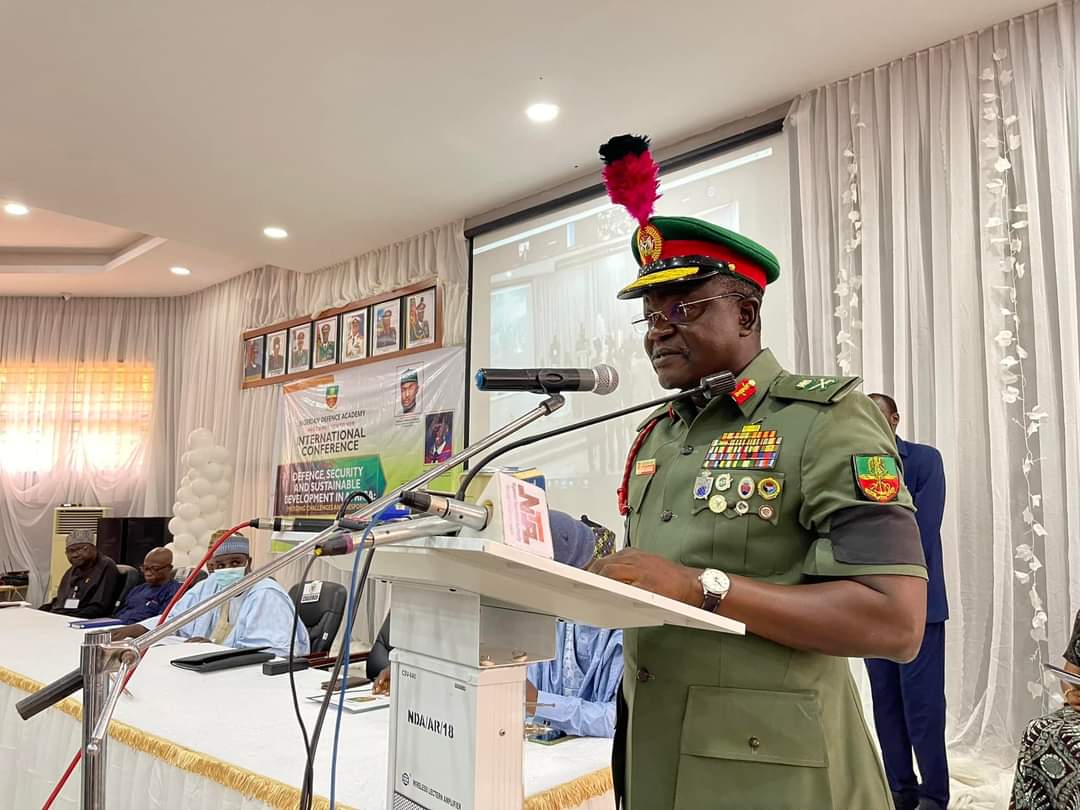
The Nigerian Defence Academy (NDA), has comissioned a Centre for early warning studies, an initiative to build a robust national database on threats to national security.
The Gamji Reporters, reports that the Centre was a collaborative initiative with the University of Ibadan.
Commissioning of the Centre on Wednesday at the NDA old site in Kaduna, was part of activities lined up for the Academy’s annual international conference with the year’s theme, “Defence, Security and Sustainable Development in Africa: Challenges and Responses”.
Speaking at the event, Commandant of the NDA, Maj.-Gen. Ibrahim Yusuf, said the Centre would collect remote and longitudinal data on the causes and incidences of violence, criminality, terrorism and insurgency in Nigeria.
He also said the Centre was established and inaugurated with a view to alerting relevant stakeholders on potential dangers and assist them to take appropriate actions.
Yusuf noted that the Centre would add value to the nation’s intelligence and security architecture by providing data that would drive a national policy and strategy.
He explained that the Centre would have two main research hubs based in the University of Ibadan and NDA, serving the southern and Northern regions of Nigeria, respectively.
“Very soon, the NDA centre will reach out to sister universities, experts and other stakeholders in the North to contribute to the work of the Centre,”Yusuf said.
He thanked the University of Ibadan for partnering with NDA to establish the Centre and assured the Vice Chancellor that they would honour their part of the partnership.
Earlier, Chairman of the conference, Prof. Munzali Jibril, explained that the year’s international conference was aimed to sustain the Academy’s established tradition of constructive engagement but would focused on defence and security in Africa.
He said that consequently, the conference would address the dynamics of, and nexus between, defence, security and sustainable development in Africa with a focus on challenges and responses at unilateral, bilateral and multilateral levels.
He said the conference has received over 130 submissions and processed a total of 118 suitable abstracts from 129 scholars and practitioners.
“These papers will be presented under 15 panels to be chaired by distinguishes professors from reputable universities across the country,”he said.
Delivering a keynote lecture, Prof. Abiodun Alao, the Director, Centre for African Leadership, King’s College, London, United Kingdom, said that in most countries with solid minerals, two things were often common with the governance of their resource.
He said it always involved multinational corporations and the extent of proper management which is often determined by the nature of the resource in question and the existing governance structure.
Alao noted that of all solid minerals, however, one of the most controversial was diamonds, largely because of the massive financial opportunities that come with its acquisition.
He explained that controversies surrounding solid minerals have caused further complications for defence and security as they have been linked with other major challenges like money laundering and smuggling.
He further said crude was next to solid minerals, noting that it is the natural resource whose governance has generated much interest and attention.
“This is due to the resource’s high degree of profitability, environmental consequences of its exploration, international nature of its politics, relevance to global economy and its role in the ethno-political and socio-economic affairs of the endowed countries,”he said.
Alao however said that fishing conflicts have been more complex in places where oil politics intermingle with fishing.
He said a number of recent conflicts in Nigeria’s Niger Delta, one of which the main problems underlining conflicts was the disruption that oil exploration has caused to fishing.
“Indeed, one of the main protests of the people in many riverine areas of Nigeria’s oil producing communities is the destruction of fishing opportunities.
“A conflict that is often forgotten in this category is the one in the Bakassi Peninsula, where the conflicts associated with fishing has been subsumed under the general controversy surrounding the ownership of the oil-rich area,”he said.
He lamented that with the economic hardship being experienced in many local communities across the continent, it is likely that water resources would be a major cause of conflict in the years ahead.
“The established dominance of internal fishing companies is likely to attract opposition from local fishermen, while unintentional trespassing will continue to affect relations between countries where local fishermen do not appreciate their limits in international boundaries.
“But as countries across the continent continue to brace themselves for the diverse implications of these, also important are the affairs of states in the politics surrounding dam constructions”.
Alao further said that Nigerai has enough resources to meet the demands of its population and ensure sustainable development.
“The reasons why the continent has not been able to maximize the opportunities from these endowments are because structures are not in place to ensure fair and equitable distribution and a string of external influences have emerged to exploit these weaknesses to their advantage.
“Africa’s main natural resource is its people, and the resilience they have shown amidst formidable odds is the asset the continent can exploit in its bid to activate the African renaissance.
“Consequently, it is the investment in its people that will offer the greatest benefit for the continent and will prevent the cycle of conflicts that has brought Africa to the focus of international concern,”Alao said.
Gamji Reporters report that the
Society of Peace Studies and Practice, conferred honorary fellowship to the first Lady of Nigerai, Hajia Aisha Buhari, and the Commandant of the NDA, Maj.-Gen. Ibrahim Yusuf.
Gamji also reports that no fewer than 450, postgraduate students and some final year cadets of the NDA were conferred
associate members of the Society.
 gamjireporters.news.blog